
The co-founder relationship
Building a solid co-founder partnership in a business is one of the hardest things for a new startups to get right. So much so that it is often listed as one of the top 10 reasons a startup fails, and why co-founder vesting periods of a minimum of four years is a recommended standard when launching a startup.
Two (or more) people rallying together to get a startup off the ground requires that those people are able to not only bridge the challenges that face the company, but the challenges that invariably come up in any relationship. Things like miscommunication, differences in values, and differences in operating styles and skills.
The great partnerships that I’ve seen are the ones where from the outset, are already setup for success, and by this I mean: skillsets are opposite yet complimentary, while values are aligned and overlapping.
This allows the founders to lean on each other for differing perspectives. It allows for the ability to divide and conquer the workload without getting in each others way, and the overlap of values means there’s a natural flow in how each person tackles the work and communicates with the other to make decisions. A mutual respect and understanding develops and allows for more of the founders time being spent in flow, rather than in conflict.
The founder relationships that struggle the most are where they have the opposite setup: I.e. skillsets that are very similar and / or values that are very different.
In this scenario, there will be more conflict between the founders either feeling like each person is stepping on the other person’s toes, or more frequent miscommunication, resulting in higher tension and a lower cadence to decision making and performance.
To illustrate this, I’ve put together a simple 2x2 matrix, and while it’s simple, it’s a good framework to use to work out where you and your co-founder(s) sit.
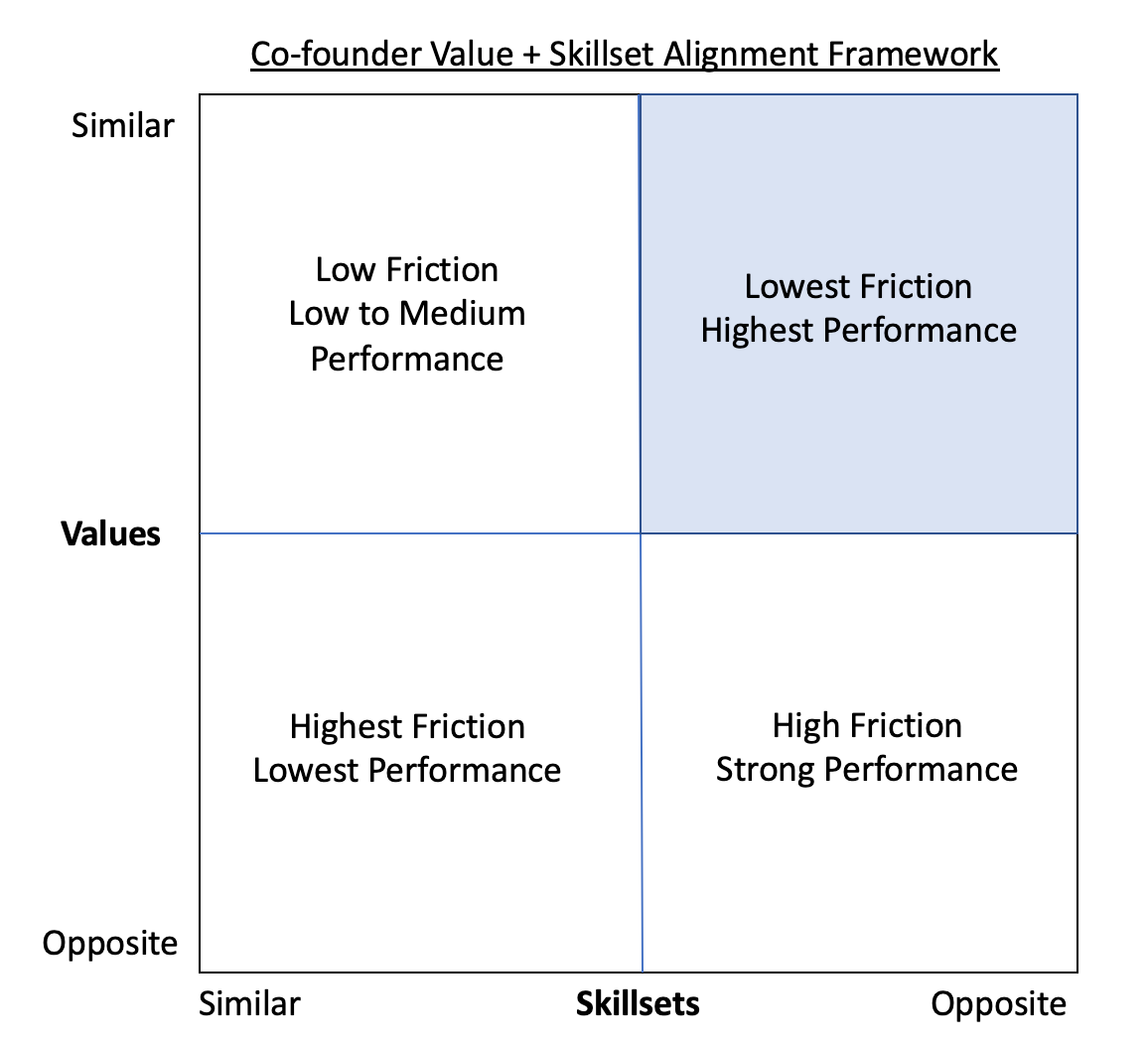
And while the framework is not an exact science, it forces a conversation between your co-founders that (if done successfully) should articulate the skillsets that each founder is able to bring to the business, what each person values the most and where potential for breakdown in the relationship exists.
Once this information is known and no longer “hidden” to one other, you can then start to work on effective interventions that aims to create stronger alignment of values and less overlap of skillsets.
If you use the framework and find yourself in:
Bottom left quadrant (High Friction; Low Performance): This is a very difficult situation to resolve and you may want to reconsider if you’ve selected the correct co-founder(s) for the business.
Bottom right quadrant (High Friction; Strong Performance): Also a tough place to be. A coach however can be very effective here in helping align values and communication styles so as to help create stronger alignment of values and reduce friction. Also helpful, is implementing more formal structures and operating guides on how decisions are made.
Top left quadrant (Low Friction; Low Performance): Here you may want to consider bringing on an additional co-founder with extremely opposite yet complimentary skillsets. This will help push up the performance of the organization. Don’t fall into the trap though of bringing in someone with the opposite skillsets but overlooking their values. It will only result in fallout.
Top right quadrant (Low Friction; High Performance): Fantastic, you’ve got the ingredients for success. Don’t rest on your laurels though. I still recommend working with a coach or trusted advisor who at times on conflict, can help you more quickly resolve the issue as well as push each founder for greater growth and performance.
Either way, building a solid co-founder relationship is difficult (that’s why the top right quadrant is called “lowest friction”). There are going to be multiple moments of conflict in the trajectory of growing the business. Expect this. But also know, that, if you’re able to navigate through those challenges successfully, it can be one of the most rewarding and personal growth producing relationships of your life.
Subscribe to A Blockchain VC and get more insights like these, delivered straight to your inbox.